


Post WW2 German Heidelberg 1948 Hitler In The Toilet Photograph
Code: 26327
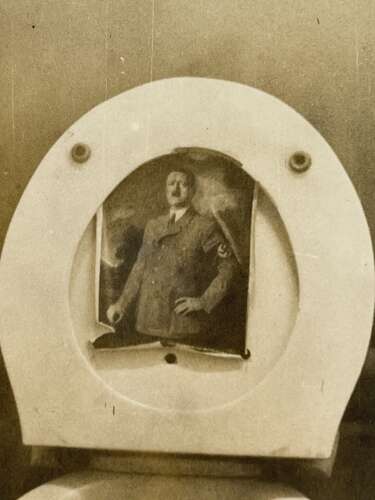
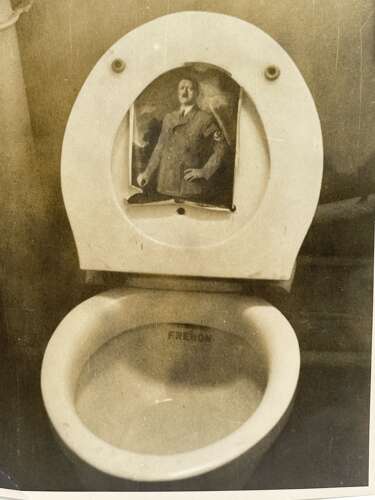
For sale is a Rare Post WW2 German Heidelberg 1948 Hitler In The Toilet Photograph.
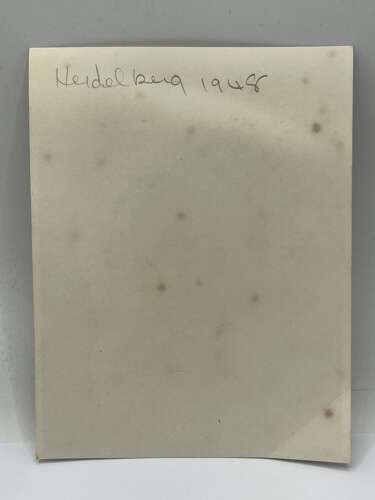
This is in good condition and marked Heidelberg 1948 on the back.
Heidelberg the fifth-largest city in the German state of Baden-Württemberg, and with a population of about 163,000, of which roughly a quarter consists of students,[4] it is Germany's 51st-largest city. Located about 78 km (48 mi) south of Frankfurt, Heidelberg is part of the densely populated Rhine-Neckar Metropolitan Region which has its centre in Mannheim.
During the Nazi period (1933–1945), Heidelberg was a stronghold of the NSDAP/Nazi party (the National Socialist German Workers' Party), the strongest party in the elections before 1933 (the NSDAP obtained 30% at the communal elections of 1930. The NSDAP received 45.9% of the votes in the German federal election of March 1933 (the national average was 43.9%). In 1934 and 1935 the Reichsarbeitsdienst (State Labor Service) and Heidelberg University students built the huge Thingstätte amphitheatre on the Heiligenberg north of the town, for Nazi Party and SS events. A few months later, the inauguration of the huge Ehrenfriedhof memorial cemetery completed the second and last NSDAP project in Heidelberg. This cemetery is on the southern side of the old part of town, a little south of the Königstuhl hilltop, and faces west towards France. During World War II and after, Wehrmacht soldiers were buried there.
Heidelberg, unlike most German cities and towns, was spared from Allied bombing raids during the war. A popular belief is that Heidelberg escaped bombing because the U.S. Army wanted to use the city as a garrison after the war, but, as Heidelberg was neither an industrial center nor a transport hub, it did not present a tactical or strategic target. Other notable university towns, such as Tübingen and Göttingen, were spared bombing as well. Allied air raids focused extensively on the nearby industrial cities of Mannheim and Ludwigshafen.
The U.S. Army may have chosen Heidelberg as a garrison base because of its excellent infrastructure, including the Heidelberg–Mannheim Autobahn (motorway), which connected to the Mannheim–Darmstadt–Frankfurt Autobahn, and the U.S. Army installations in Mannheim and Frankfurt. The intact rail infrastructure was more important in the late 1940s and early 1950s when most heavy loads were still carried by train, not by truck. Heidelberg had the untouched Wehrmacht barracks, the "Grossdeutschland Kaserne" which the US Army occupied soon after, renaming it the Campbell Barracks.
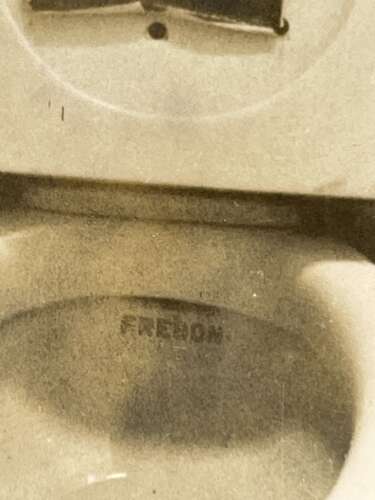
This photograph is in excellent and shows Hitlers portrait hung in the toilet.
This will be sent via Royal Mail tracked 24 and dispatched within two working days.
