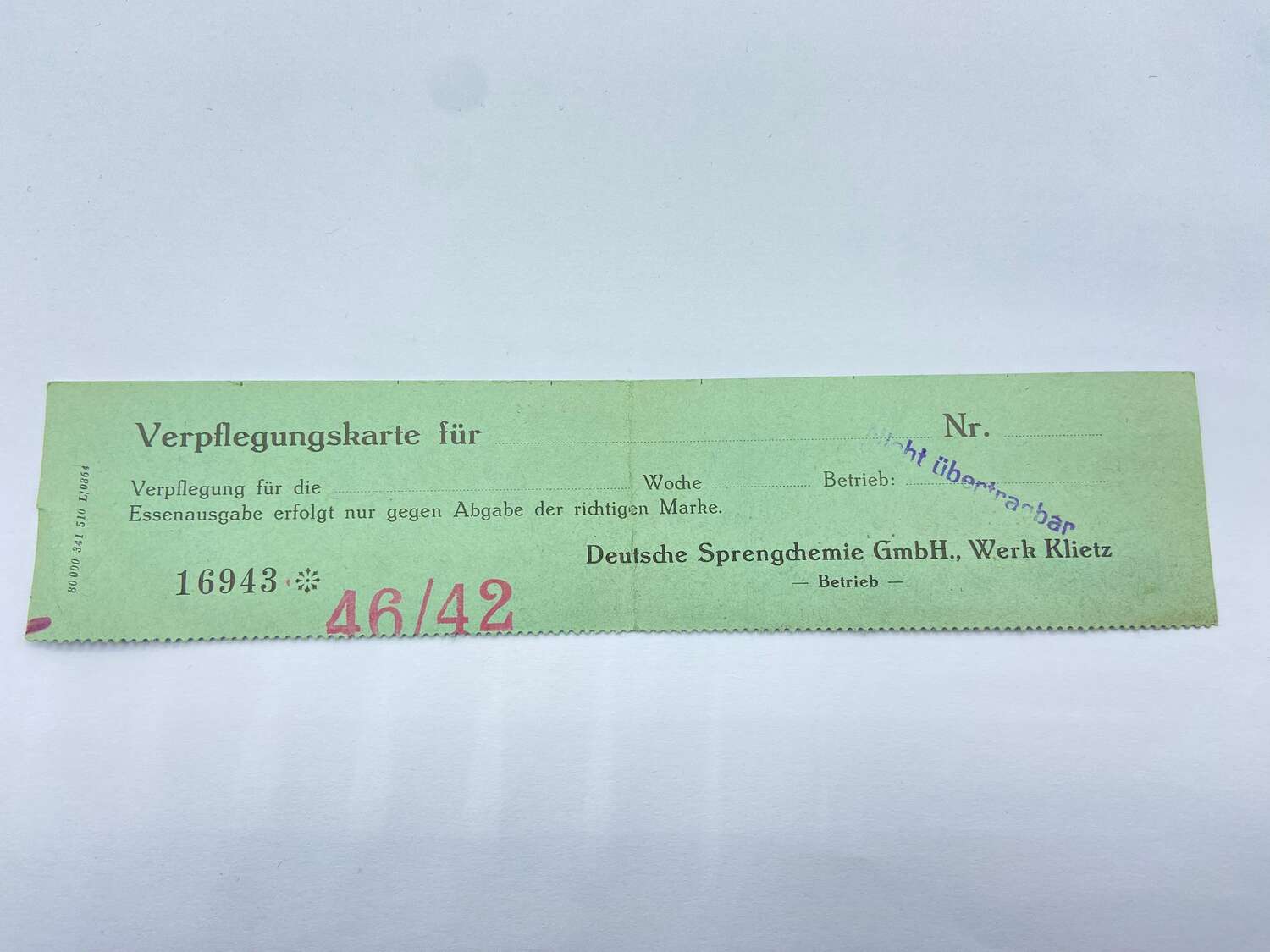


WW2 German Secret-Deutsche Sprengchemie GmbH Klietz Meal Card
Code: 24272
(1 in stock)
For sale is a WW2 German Secret-Deutsche Sprengchemie GmbH Klietz Meal Card.
This is a war issue number “16943” for a “Verpflegungskarte” (meal card). This meal card is a green slip, which was unissued. This measures 21cm length x 5cm height.
The meal card states in german:
“Verpflegungskarte fur: Nr: Verpfoegung fur die ……… woche…… betrieb……. essenausgabe erfolgt nur gegen abgabe der richtigen marke. 49809. Deutsche Sprengchemie GMBH werk klietz- betrieb. 80 000 341 510 L/0864 46/42 nicht ubertragber”
This translates to English:
“Meal card for: No: Meals for the ……… week…… company……. Food is only served against delivery of the correct brand. 49809. Deutsche Sprengchemie GMBH plant klietz-betrieb. 80 000 341 510 L/0864 46/42 not transferable”
History of Deutsche Sprengchemie GmbH Klietz Explosives-plant:
Foundation of Deutsche Sprengchemie GmbH
- In 1934, the Reich Defense Council issued the instructions / decisions on
- Increasing the capacity of explosive production and
- Construction of explosive plants in the wild, far away from the industrial conurbations
- Development of arms production by large corporations such as SIEMENS, AEG, I.G.
Paint industry A.G. and others
- Foundation of the umbrella organization, MONTAN - Industrie GmbH as a link between the state and
Industry
- October 1934, foundation of Deutsche Sprengchemie GmbH (DSC)
Overview of the plants of Deutsche Sprengchemie GmbH
Geretsried Bavaria 1939 Codename TAL
Kraiburg Bavaria 1940 Codename FICHTE
Forest /Scheuno Poland 1941 Codename FOREST
Dreetz Brandenburg 1942 Codename AUE
Klietz Saxony - Anhalt 1936 Codename BISMARK
Oderberg Brandenburg 1939 Codename DAMM
Torgelow Mecklenburg - Western Pomerania 1939 Code name SEE
Moschwig Saxony - Anhalt 1937 Codename BUCHE
Overview of the production site:
Low-smoke-gunpowder was produced with solvents (nitrocellulose-powder of various types, niperite or Nitropentan-powder) and, among other things, the production and filling of edible-explosives in grenades-with different uses as splinter-grenades, explosive-grenades and armoredgrenades. The total production from 1937 to 1945 was approx. 37. 500t-gunpowder. Of which about 93% nitrocellulose-powder, approx. 6% Niperite-or-Nitropentan-powder and about 1% other powder. The explosives-plant also included the power plants I and II, a fire site for testing the properties of-gunpowder, a shooting-range for testing the ammunition-and the "Heide" warehouse. Here were about 1. 400 workers are accommodated for the explosives-plant (97.5% eastern workers, mostly women with 77%). The warehouse was guarded by factory protection and was surrounded by a barbed wire fence. In addition to the accommodation and crew barracks, the-camp also had a communal barrack, the economic barrack, a pigsty, the potato warehouse, fire extinguishing pond, the command and administration, medical supply office, delousing barrack and rescue center of the DSCM, guest barracks as well as several toilets and sewage treatment plant. There were also several air raid trenches in the camp-site. In 1945, the armaments-factory was blown up by corresponding decisions of the Potsdam Agreement. From the mid-1950s, the Barracks People's Police (CIP), riot police and the National People's Army (NVA) begin to use and convert and expand part of the site, today's bunker complex Kossa.
Secret project BUCHE:
From 1935, building materials, workers and supplies were transported here for the construction of the Moschwig-explosives-plant, code name "Project BOOK". This idyllic area was found by the "Westsächsisch-Anhaltinische Sprengstoff AG (WASAG), a subsidiary of the "Deutsche Sprengstoff Chemie Moschwig (DSC), suitable for the construction of an ammunition-factory-and production of explosives-and-began the extensive construction activities.
In the mid-1930s, the secret construction project BUCHE began in an idyllic beech forest in the structurally weak area of the Söllichau Forest in the Dübener Heide. On an area of about 440ha, another important explosives-plant for the defense industry of the Third-Reich-was to be built. The total cost was approx. 44 million Reichsmark and the production of explosives-was-already started in 1937. The client of the construction project was the Reich-government, which released the armaments-budget, the necessary funds were then released by the High-Command of the Army after detailed examination. The contractor was MONTAN - Industrie GmbH, it received the funds and forwarded them to Deutsche Sprengstoff Chemie AG.
The work itself was divided into the: Appendix I. Nitocellulose-powder plant with a size of 215ha. The production of gunpowder-began in April 1937.
Annex II and III. Nitrocellulose-powder - plant, the production of gunpowder-was started in May 1938.
Appendix IV. Nitropentan-powder - plant with the start of production in August 1939. Gunpowder-for-longer ranges was produced here.
Appendices II, III and IV had an area of 175ha.
The filling systems for grenades-and-projectiles-began in October 1940 and August 1941 on an area of 50ha. with the works.
This will be sent via Royal Mail 1st class signed for and dispatched within two working days.
