



Beautiful WW1 His Majesty’s Hospital Ship Vita Indian Carved Wooden Box
Code: 25698
(1 in stock)
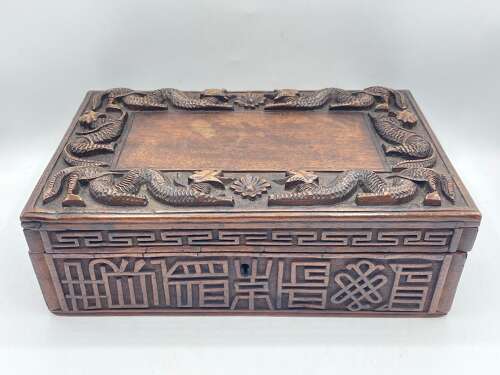
For sale is Beautiful WW1 His Majesty’s Hospital Ship Vita Indian Carved Wooden Document Box.
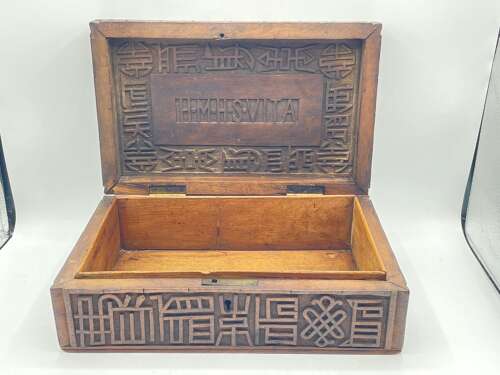
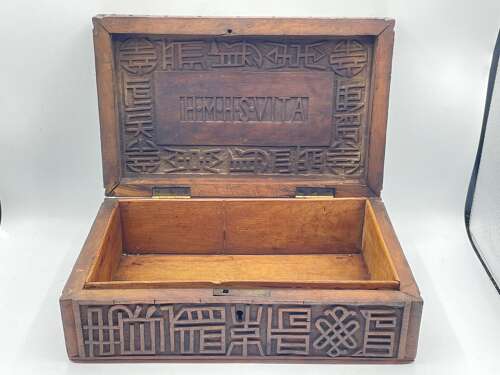
This is beautifully carved with Indian dragons and symbols, and inside the top panel is a section carved “H.M.H.S Vita” which stands for his majesty’s hospital ship Vita.
This beautiful box measures 28cm in length x 18cm width x 9.5cm height. This carved box was most likely commissioned or carved by an Indian personnel who worked on the ship.
About HMHS Vita:
VITA was a 4, 691 grt Passenger/Cargo ship ordered by the British India Steam Navigation Co. Ltd., (B.I.S.N.) Glasgow from Swan, Hunter & Wigham Richardson Ltd, Wallsend, Newcastle-upon-Tyne. She was laid down as Yard number 934 and launched on August 24th 1914. Designed to accommodate 2,748 passengers; 32 1st, 24 2nd, and 2,694 deck passengers and 2,800 cubic feet of refrigerated cargo she was the third of four V-class ships to be delivered and for the British India Steam Navigation Co. for their Bombay to Persian Gulf service; the others being named VARELA, VARSOVA and VASNA. Completed in October 1914 at a cost of £119,700.
On October 17th 1914 she was requisitioned for military service, on departure from her builder’s yard she sailed as an Indian Expeditionary Force Troopship. The S.S. VITA was manned by her B.I.S.N. crew, Captain F. R. Commack in command and was to be based out of Bombay, the port from which she would have sailed on commercial service.
She initially operated in the Persian Gulf but in November 1915 she sailed for France to embark troops. She embarked the men and equipment of the 16th Infantry brigade at Marseilles on December 21st 1915, after calling at Malts the SS VITA entered the Suez canal on January 3rf 1916, arriving at Basra on the 20th and disembarked her troops the following day. She now remained at Basra and was to be employed in a medical capacity in March, when she embarked a Medical Officer with practical knowledge of Plague and an Assistant Surgeon skilled in Bacteriology for passage to the Troopship NILE which had am outbreak amongst the troops on board. She departed Basra on March 2nd and on rendezvous the decision was taken to transship the men to VITA for passage to Basra; on the 7th it was decided to Quarantine and disinfect troops on both the VITA and NILE.
On her arrivals at Bombay on completion of her Quarantine period VITA was chosen for conversion into a Hospital Ship. Her transformation into a Hospital Ship appears to be rudimentary, possibly carried out at the Royal Indian Marine Dockyard at Bombay. She emerged with a capacity to accommodate 405 wounded and sick in patients in 10 wards. Including 32 officers, 16 British and 16 Indian, 9 Warrant Officers, and 364 other ranks in cots and berths.
VITA was an “Indian” Hospital Ship under the military command of the Indian [Army] Medical Service (I.M.S.). The ship continued to manned by her B.I.S.N. crew and the hospital was staffed by a mix of army units under Major S. H. Lee Abbott,, I.M.S. as senior medical officer also Officer Commanding Troops. She carried a large Indian staff along with the British one. There would have been as many as 100 Indian staff members on board filling a variety of roles such as sub-assistant surgeons, dispensers, Hindu and “Mohammedan” cooks, tailor, sweepers, dhobis, ward orderlies and servants. Doctors and Surgeons were drawn from both the RAMC and I.M.S. In addition to their medical duties, these men also filled administrative duties, for example the roles of Adjutant, Surgical & Medical Stores officer, C.O. RAMC, and C.O. Indian Personnel.
A small Female nursing staff of Ward Sisters, Staff Nurses and probationary Nurses included women from the Australian Army Nursing Service (A.A.N.S.), the Queen Alexandra’s Military Nursing Service, India (Q.A.M.N.S.I.), Queen Alexandra’s Imperial Military Nursing Service Reserve (Q.A.I.M.N.S.R.), and the South African Military Nursing Service (S.A.M.N.S.); they came under the command of an on-board Matron and a Sister-in-Charge. Her medical personnel joined her at Bombay prior to sailing for Basra, Iraq, at the head of the Persian Gulf to begin operations in May 1916, arriving at Basra on May 21st. At Basra she embraced 17 Officers and 341 other ranks for passage to Bombay, arriving back on the 29th. While at Bombay she embarked the personnel of No 33 British General Hospital (BCH) 33 Officers and 187 other ranks for passage to Basra. On arrival there on June 11th No 33 BGH was established ashore in a tented camp at Tanoumah on the right bank of the Shatt-al-Arab River.
VVITA operate between Bombay and Basra until November 1916 when she was ordered to proceed to East Africa; she arrived at Zanzibar on December 9th and Dar-es-Salaam on the 11th before returning to Zanzibar. She sailed to return to Bombay on December 17th. She resumed her normal duties from January 1917 and received some modification work at Bombay in July, including replacing swing cots with fixed double tiered cots in wards 1, 2 & 4 Increasing patient accommodation to 436, the the ventilation system was tested and repaired as well as Wards 1, 2, 3,, 4, 6 & 10 were painted. She then sailed for Basra. On September 10th Major J. Husband, I.M.S., arrived as the new O.C. Troops.
In October 1917 VITA was again allocated to operate in East Africa, she sailed for DAR-ES-SALAAM on October 24th. On November 3rd she arrived at the Tanzanian coastal town of Lindi where she embarked 410 patients, including African and Indian troops, 78 of which were stretcher cases. She sailed for Dar-es-Salaam the following afternoon. On arrival the next day she disembarked her patients before sailing foe Zanzibar on the 6th. After coaling and taking on stores she arrived back at Lindi on November 10th; this was be her operational area for the next 6½ months.
Once on station her primary function was to sail form Dar-es-Salaam to Lindi, embarked sick and wounded for passage back to Dar-es-Salaam, sometimes as many as three round trips am month. In addition she transported patients from Dar-es-Salaam to Kilindini when required. Calls were made at Zanzibar when she needed to take on coal and water.
In March 1918 she began calling at to Port Amelia, Mozambique, 380 miles south of Lindi. On her first voyage she embarkeded54 Portuguese East African Porters at Dar-es-Salaam and a further 325 were embarked at Lindi; all were disembarked at Port Amelia on the afternoon of the 18th. On the 20th she embarked 299 sick and wounded for passage to Dar-es-Salaam via Lind where she embarked a further 139 patients, arriving at Dar-es-Salaam on the 23trd.
She sailed for a second voyage to Port Amelia on April 5th to embark another 416 sick and wounded on the 8th for passage to Dar-es-Salaam. She then resumed her normal round of voyages until she sailed for South Africa with 383 patients for Simons’ town, departing Dar-es-Salaam on May 18th. Arriving at Durban on the morning of the 25th 143 patients were disembarked. 22 were embarked on the 26th for passage to Cape Town on the 26th when she departed Durban. She went alongside in Cape Town on the morning of May 31st and all patients were disembarked by noon. Sher was at Cape Town for repair work to be carried out and entered dry-dock on June 2nd for a hull scrape and repairs, being undocked on the 5th. While in dockyard hands all ward beds and fittings were repainted. She sailed for Bombay on the 10th calling at Durban and Zanzibar, where she took on stores before arriving in Bombay harbour on the 30th. During her time based out of Dar-es-Salaam VITA carried approximately 12,240 sick and wounded, or 2,000 a month.
VITA was to spend the next 6½ weeks under repair moored in the stream at Bombay in preparation for returning to operations in the Persian Gulf; a number of personnel changes were also made during this period. Work complete she sailed for Basra on the morning of August 17th, arriving there on the 23rd. On the 25th she embarked 393 sick and winded for transfer to Karachi and Bombay, sailing the same day. She disembarked 190 men at Karachi on the 30th, embarking 2 additional men for Bombay. She arrived back at Bombay on September 1st, and disembarked all patients the next day. More personal adjustments took place, including Major J. J. Robb, IMS relieved Major J. Husband, IMS as O.C. Troops.
Her next voyage was scheduled to be a return to Basra but this was changed to Suez, and she sailed for Aden on September 13th. On arrival At Port Suez on September 24th. She embarked 426 sick for passage to Bombay on the 29th and sailed the following day. Calling at Aden on October 5th she embarked 28 more sick for Bombay. All patients were disembarked on reaching Bombay on October 11th. She sailed for Suez again on the 16th, arriving three on the 27th. She embarked 432 patients on November 2nd for the return voyage to Bombay, and sailed the following day. All patients were disembarked at Bombay on the 19th. VITA remained at anchor in Bombay bay until December 5th when she embarked 346 patients for passage to Suez, sailing later that day, all were disembarked at Suez on the 16th. For the return voyage 358 patients were embarked on the 20th and she sailed the following day. Calling at Aden on the 26th she embarked a farther 60 patients. She arrived back At Bombay on New Year’s Day 1919 and disembarked all on the 2nd.
VITA entered dry dock on January 3rd for repairs and alterations to convert her into an Ambulance Transport. She was undocked on the 6th and moved to Berth 17, Alexandra Dock. A large turnover of medical staff now took place before she sailed for Basra on January 14th for her first round trip in her new role. At Basra she embarked 370 patients on the 22nd for passage to Bushire, Iran and Karachi and Bombay, India sailing that day.
VITA continued to operate as an Ambulance Transport until at least February 28th 1921 which the last recorded wear diary entry for the ship. On release from military service she was returned to the British India Steam Navigation Co. Ltd., and after spending time in dockyard hands for remodelling she entered commercial service on the company’s Persian Gulf routes.
HMHS Vita was also requisitioned for military service during World War Two. She was attacked by enemy bombers in 1941. After 5½ years’ service as a Naval Hospital Ship VITA was to be prepared for decommissioning and returned to her owners; her time at Trincomalee was her last tour of duty as a Naval Hospital Ship. She entered commercial service as the S.S. VITA, a passenger, Cargo, mail ship on the Calcutta to Rangoon service in May 1946. Her post war career was brief however, sonly 3 years, she was sold for scrap and was broken up by Hindustan Iron Works at Bombay beginning on May 20th 1949.
This is in mostly good condition, the engaging tooth of the box is missing and would need to be replaced.
This will be sent via parcel force express 24 and dispatched within two working days.
